Insights · Business
Disaster Recovery Planning Ireland for IT Failures
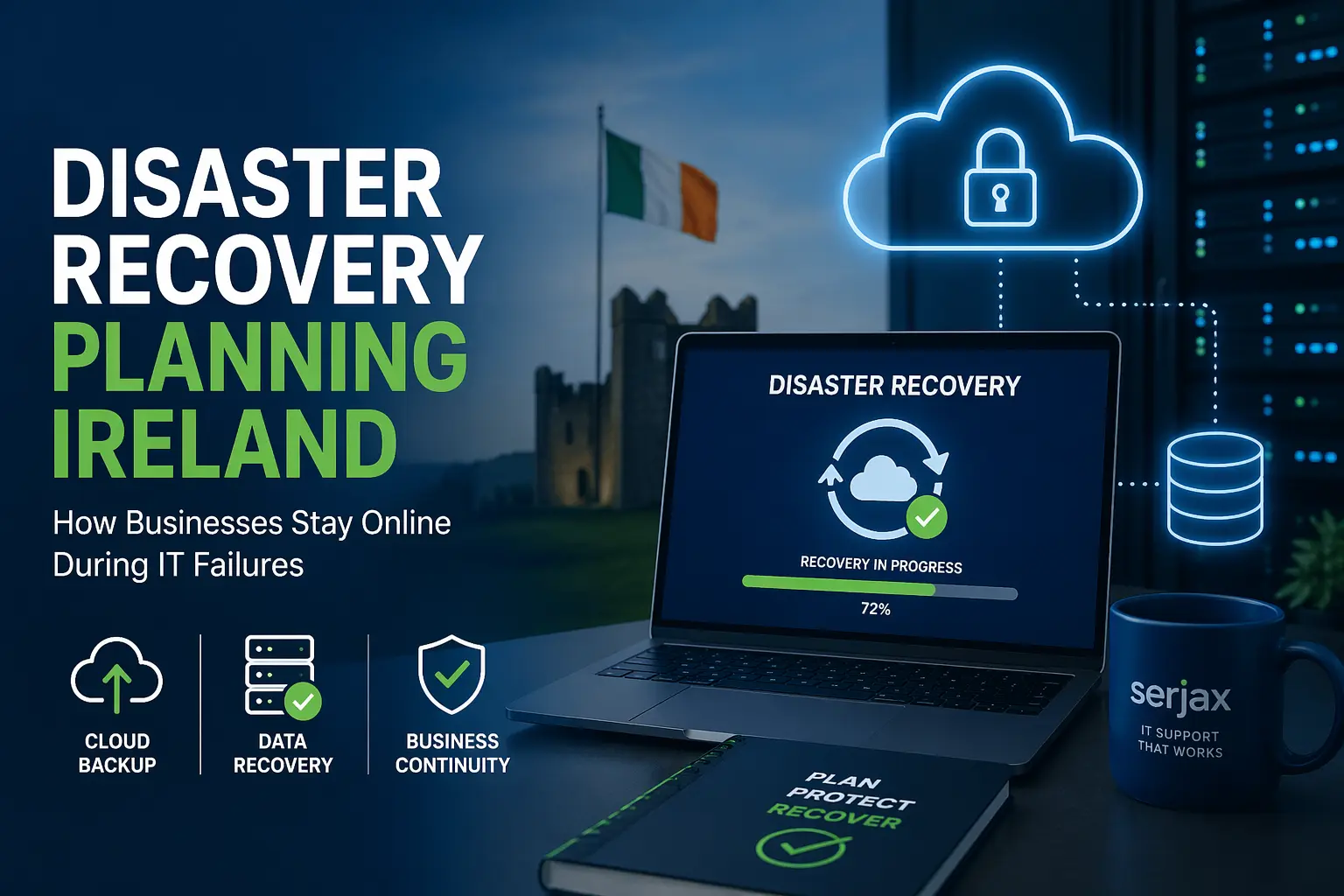
In today’s digital-first economy, even a few minutes of downtime can cost Irish businesses thousands of euros, damage customer trust, and disrupt critical operations.
Therefore, disaster recovery planning (DRP) has become an essential part of modern IT strategy—especially for companies in Ireland that rely heavily on cloud services, data systems, and remote connectivity.
In this comprehensive guide, we will explore how Irish businesses stay online during IT failures, what disaster recovery planning involves, and how IT service providers like Serjax help organizations build resilience against unexpected disruptions.
What Is Disaster Recovery Planning?
Disaster Recovery Planning (DRP) is a structured approach that ensures a business can quickly restore IT systems, data, and operations after a disruption.
These disruptions may include:
- Cyberattacks (ransomware, phishing, data breaches)
- Hardware or server failures
- Power outages
- Cloud service downtime
- Natural disasters or physical damage
- Human error or system misconfiguration
Importantly, DRP is not just about backup—it is about business continuity, ensuring operations continue with minimal interruption.
Why Disaster Recovery Is Critical for Irish Businesses
Ireland has become a major European hub for technology companies, SMEs, and global corporations. As a result, dependency on IT systems is extremely high.
Moreover, with increasing cyber threats across Europe, Irish businesses face more risks than ever before.
Key reasons DRP is essential:
- Minimizes downtime and financial losses
- Protects customer trust and brand reputation
- Ensures compliance with EU GDPR regulations
- Improves cyber resilience against ransomware attacks
- Supports remote and hybrid working environments
Furthermore, businesses without a DR plan often struggle to recover fully after a major incident.
Core Components of a Disaster Recovery Plan
A strong disaster recovery strategy includes multiple layers of protection and recovery mechanisms. Below is a structured breakdown:
1. Risk Assessment and Business Impact Analysis
First and foremost, businesses must identify:
- Critical systems and applications
- Data dependencies
- Potential threats
- Financial impact of downtime
This helps prioritize recovery efforts effectively.
2. Data Backup Strategy
Data backup is the backbone of disaster recovery.
Common backup methods include:
- Cloud backups
- Off-site storage
- Incremental backups
- Real-time replication
3. Recovery Time Objective (RTO) and Recovery Point Objective (RPO)
These two metrics define recovery expectations:
| Term | Meaning | Example |
|---|---|---|
| RTO | Maximum time allowed to restore systems | 2 hours downtime max |
| RPO | Maximum acceptable data loss | 15 minutes of data |
4. Failover Systems
Failover systems automatically switch operations to a secondary system when the primary one fails.
For example:
- Primary server crashes → backup server activates instantly
5. Communication Plan
During an IT disaster, communication is crucial. A good plan includes:
- Internal staff alerts
- Customer notifications
- IT escalation procedures
6. Testing and Maintenance
Even the best DR plan is useless without regular testing.
Businesses should:
- Run simulation drills
- Test backup restoration
- Update systems regularly
Types of Disaster Recovery Solutions Used in Ireland
Irish companies typically use a combination of modern IT recovery solutions.
1. Cloud-Based Disaster Recovery (DRaaS)
Disaster Recovery as a Service (DRaaS) is widely used because it is:
- Scalable
- Cost-effective
- Fast to deploy
It allows businesses to replicate systems in the cloud and restore them instantly.
2. On-Premises Backup Systems
Some organizations still maintain local backup servers for faster internal recovery.
However, these are usually combined with cloud solutions for redundancy.
3. Hybrid Disaster Recovery Models
A hybrid model combines:
- On-premises infrastructure
- Cloud backup systems
This approach offers maximum flexibility and reliability.
4. Fully Managed IT DR Services
Companies like Serjax provide fully managed disaster recovery solutions, which include:
- Monitoring systems 24/7
- Automated backups
- Rapid recovery execution
- Cybersecurity integration
How Irish Businesses Stay Online During IT Failures
Now, let’s look at how businesses in Ireland actually maintain uptime when disasters strike.
1. Real-Time Data Replication
Data is continuously copied to backup systems. Therefore, if a system fails, the backup is nearly up to date.
2. Automated Failover Systems
Instead of manual recovery, automated systems instantly switch to backup infrastructure.
As a result, downtime is significantly reduced.
3. Cloud Infrastructure Redundancy
Irish businesses often use cloud providers with multiple data centers. Consequently:
- If one server fails, another takes over
- Services remain uninterrupted
4. Endpoint Protection and Cybersecurity Layers
Cyberattacks are a major cause of IT failures. Therefore, businesses deploy:
- Firewalls
- Endpoint detection tools
- Anti-malware systems
- Multi-factor authentication
5. IT Support and Monitoring Services
Continuous monitoring ensures early detection of issues. IT teams can resolve problems before they escalate into full outages.
Role of Serjax in Disaster Recovery Planning
Serjax plays a key role in helping Irish businesses build resilient IT environments.
They offer:
- Customized disaster recovery strategies
- Cloud backup and DRaaS solutions
- Cybersecurity integration
- 24/7 IT monitoring and support
- Business continuity consulting
Moreover, Serjax focuses on proactive prevention rather than reactive recovery, which significantly reduces downtime risks.
Benefits of a Strong Disaster Recovery Plan

Implementing a DRP provides multiple business advantages:
Business Benefits:
- Faster recovery after incidents
- Reduced operational downtime
- Improved customer trust
- Enhanced cybersecurity posture
- Better regulatory compliance
Financial Benefits:
- Lower recovery costs
- Reduced revenue loss during outages
- Predictable IT budgeting with cloud solutions
Common Mistakes Irish Businesses Make
Despite awareness, many companies still make critical mistakes:
- No formal disaster recovery plan
- Infrequent backup testing
- Relying on a single data center
- Ignoring cyber threats
- Outdated recovery documentation
Consequently, recovery becomes slower and more expensive when disasters occur.
Best Practices for Disaster Recovery Planning
To build a strong DR strategy, businesses should follow these best practices:
- Conduct regular risk assessments
- Use cloud-based backup solutions
- Define clear RTO and RPO targets
- Test recovery systems quarterly
- Train employees on emergency protocols
- Partner with managed IT providers like Serjax
Additionally, continuous improvement is essential as threats evolve rapidly.
Future of Disaster Recovery in Ireland
The future of disaster recovery is becoming more advanced and automated.
Key trends include:
- AI-powered threat detection
- Zero-downtime cloud migration
- Fully automated recovery systems
- Increased adoption of DRaaS
- Stronger EU cybersecurity regulations
Therefore, Irish businesses must continuously upgrade their IT resilience strategies to stay competitive.
Conclusion
Disaster recovery planning is no longer optional it is a necessity for Irish businesses operating in a digital and highly connected environment. From cyberattacks to system failures, threats can occur at any time.
However, with a well-structured DR strategy, businesses can ensure continuity, minimize downtime, and protect both revenue and reputation.
By leveraging modern cloud solutions, automated systems, and expert providers like Serjax, Irish companies can stay online even during major IT failures.
Ultimately, the goal is simple: keep business running no matter what happens.
FAQ’s
1. What is disaster recovery planning in IT?
Disaster recovery planning is a strategy that helps businesses restore IT systems and data after unexpected disruptions such as cyberattacks, hardware failures, or outages.
2. Why is disaster recovery important for Irish businesses?
It ensures business continuity, reduces downtime, protects sensitive data, and helps comply with GDPR regulations.
3. What is the difference between backup and disaster recovery?
Backup refers to storing copies of data, while disaster recovery includes restoring entire systems and maintaining business operations.
4. How often should a disaster recovery plan be tested?
Ideally, businesses should test their disaster recovery plan at least every 3–6 months.
5. What services does Serjax provide for disaster recovery?
Serjax offers cloud backup, disaster recovery as a service (DRaaS), cybersecurity solutions, IT monitoring, and business continuity planning.
6. Can small businesses in Ireland afford disaster recovery solutions?
Yes. Cloud-based and managed DR services are scalable and cost-effective, making them suitable for SMEs as well as large enterprises.
More from Serjax: cloud backup & disaster recovery · AI consultancy · managed IT services