Insights · cybersecurity
Cybersecurity Threats Targeting Irish Businesses in 2026
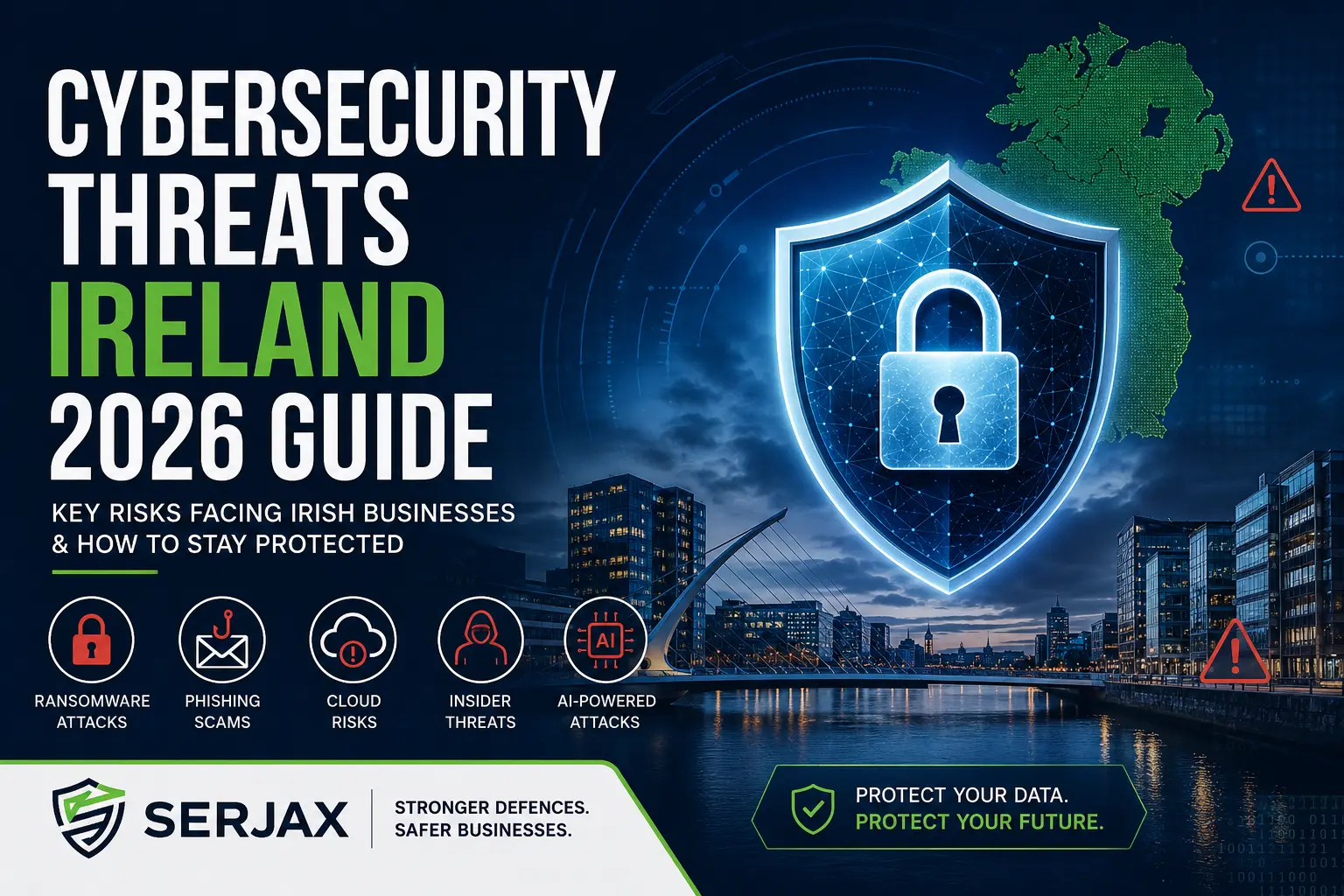
Cybersecurity threats Ireland are increasing rapidly in 2026, and businesses across the country are becoming prime targets for cybercriminals.
As digital transformation accelerates, organizations are relying more on cloud systems, remote work tools, and online platforms. However, this growth also expands the attack surface for hackers.
Therefore, cybersecurity is no longer optional it is a business necessity. Companies that fail to secure their systems risk financial loss, data breaches, and reputational damage. In addition, attackers are now using advanced tools like AI, making threats more sophisticated than ever.
In this guide, we will explore the most dangerous cyber risks affecting Irish businesses, how they work, and what protective strategies can be implemented. Moreover, we will highlight how Serjax helps businesses build strong, scalable cybersecurity defenses.
Why Cybersecurity Threats Are Increasing in Ireland
Ireland has become a major European hub for global tech companies, financial institutions, and cloud service providers. As a result, cybercriminals see Irish businesses as high-value targets.
Several key factors are driving this increase:
- Rapid adoption of digital technologies
- Growth of remote and hybrid working models
- Heavy dependency on cloud platforms
- Lack of cybersecurity awareness in SMEs
- Rise of AI powered cyberattacks
Additionally, attackers are no longer focusing only on large corporations. Small and medium-sized businesses are increasingly targeted because they often have weaker security systems.
Major Cybersecurity Threats Facing Irish Businesses in 2026
Understanding the threat landscape is the first step toward protection. Below are the most critical cybersecurity risks in Ireland today.
Ransomware Attacks
Ransomware remains one of the most destructive cyber threats. In these attacks, hackers encrypt business data and demand payment to restore access.
Typically, these attacks begin through phishing emails or compromised credentials. Once inside the system, attackers lock files and disrupt operations.
Key risks include:
- Complete system shutdown
- Loss of critical business data
- Financial extortion
- Long recovery time
Even if the ransom is paid, data recovery is not always guaranteed.
Phishing and Social Engineering Attacks
Phishing attacks are becoming more advanced and harder to detect. Cybercriminals now use AI tools to create highly convincing emails and messages.
Common phishing tactics include:
- Fake login pages
- Fraudulent invoice requests
- CEO impersonation emails
- Fake account verification alerts
Moreover, attackers often create urgency to trick employees into making mistakes. Therefore, awareness training is essential.
Cloud Security Misconfigurations
As more Irish companies move to cloud-based systems, misconfiguration risks are increasing.
Common issues include:
- Publicly exposed databases
- Weak user permissions
- Lack of encryption
- Poor identity management
As a result, sensitive business data can be exposed without any direct hacking effort.
Insider Threats
Insider threats occur when employees or contractors misuse access to company systems.
These threats can be:
- Intentional (data theft or sabotage)
- Accidental (human error or negligence)
Examples include weak password usage, unauthorized downloads, or sharing sensitive data.
Although often overlooked, insider threats can be extremely damaging.
AI-Powered Cyber Attacks
Cybercriminals are now using artificial intelligence to automate and scale attacks. This makes cyber threats faster, smarter, and more dangerous.
AI is being used for:
- Deepfake based scams
- Automated phishing campaigns
- Malware generation
- Password cracking systems
Consequently, traditional security solutions are no longer enough.
Comparison of Cybersecurity Threats in Ireland
| Threat Type | Risk Level | Business Impact | Common Target |
|---|---|---|---|
| Ransomware | Very High | Data loss, downtime | All industries |
| Phishing | High | Credential theft | Employees |
| Cloud Misconfiguration | High | Data exposure | Tech companies |
| Insider Threats | Medium | Internal data leakage | Enterprises & SMEs |
| AI-Based Attacks | Very High | Scalable cyber breaches | All businesses |
Business Impact of Cybersecurity Threats in Ireland
Cybersecurity incidents can severely impact organizations in multiple ways.
Financial Losses
Businesses often suffer direct financial theft, ransom payments, and recovery costs. In addition, downtime leads to revenue loss.
Operational Disruption
When systems go offline, business operations stop completely. This reduces productivity and affects customer service.
Reputation Damage
Customers lose trust after a data breach. As a result, long-term brand damage can occur.
Legal and Compliance Issues
Businesses may also face regulatory penalties if they fail to protect customer data properly.
How Irish Businesses Can Prevent Cybersecurity Threats

Fortunately, there are several effective strategies to reduce cyber risks.
Employee Awareness Training
Employees should be trained to:
- Identify phishing emails
- Use strong passwords
- Report suspicious activity
Regular training significantly reduces human error.
Multi-Factor Authentication (MFA)
MFA adds an extra layer of protection. Even if passwords are stolen, accounts remain secure.
Regular Software Updates
Outdated software is a major vulnerability. Therefore, timely updates and patching are essential.
Secure Cloud Configuration
Cloud systems must be properly configured with:
- Role-based access control
- Encryption
- Monitoring systems
Data Backup Strategy
Regular backups ensure business continuity after cyberattacks. Ideally, backups should be stored securely and tested frequently.
Partnering with Serjax for Cybersecurity
Many Irish businesses are now partnering with Serjax to strengthen their cybersecurity infrastructure.
Serjax provides:
- Real-time threat monitoring
- Network security solutions
- Cloud protection services
- Compliance support
- Risk assessment and prevention strategies
As a result, businesses can focus on growth while security experts handle protection.
Emerging Cybersecurity Trends in Ireland (2026)
Cybersecurity is evolving rapidly. Key trends include:
- Rise of AI driven cyberattacks
- Adoption of zero trust security models
- Stronger government regulations
- Increased cybersecurity insurance adoption
- Growth of managed security services
Therefore, businesses must stay proactive rather than reactive.
Best Practices Summary
To stay protected, Irish businesses should:
- Strengthen access controls
- Train employees regularly
- Secure cloud infrastructure
- Monitor systems continuously
- Work with cybersecurity experts like Serjax
Consistency is key because cybersecurity is an ongoing process.
Conclusion
In conclusion, cybersecurity threats Ireland are becoming more advanced, frequent, and damaging in 2026. From ransomware to AI-driven attacks, businesses face serious risks that can impact operations and trust.
However, with the right strategy combined with employee awareness, strong technical controls, and expert support from Serjax organizations can significantly reduce their vulnerability.
Ultimately, cybersecurity is not just about defense; it is about ensuring long-term business stability in a digital-first world.
Read More: Disaster Recovery Planning: How Irish Businesses Stay Online During IT Failures
FAQ’s
What are the biggest cybersecurity threats in Ireland?
The biggest threats include ransomware, phishing attacks, cloud misconfigurations, insider threats, and AI based cyberattacks.
Why are Irish businesses targeted by hackers?
Because Ireland hosts many global companies and digital infrastructure, making it a high value target for cybercriminals.
How can small businesses improve cybersecurity?
They can improve security by training staff, using MFA, updating systems regularly, and partnering with experts like Serjax.
What is the most dangerous cyber threat in 2026?
Ransomware and AI powered attacks are currently the most dangerous threats.
Is cloud security safe for businesses in Ireland?
Yes, but only if properly configured with strong access controls, encryption, and monitoring.
More from Serjax: cyber security services · top cybersecurity solutions for 2026 · IT compliance in Ireland