Insights · Technology
Managed IT vs Break-Fix IT Support: Which Model Is Better for Your Business?
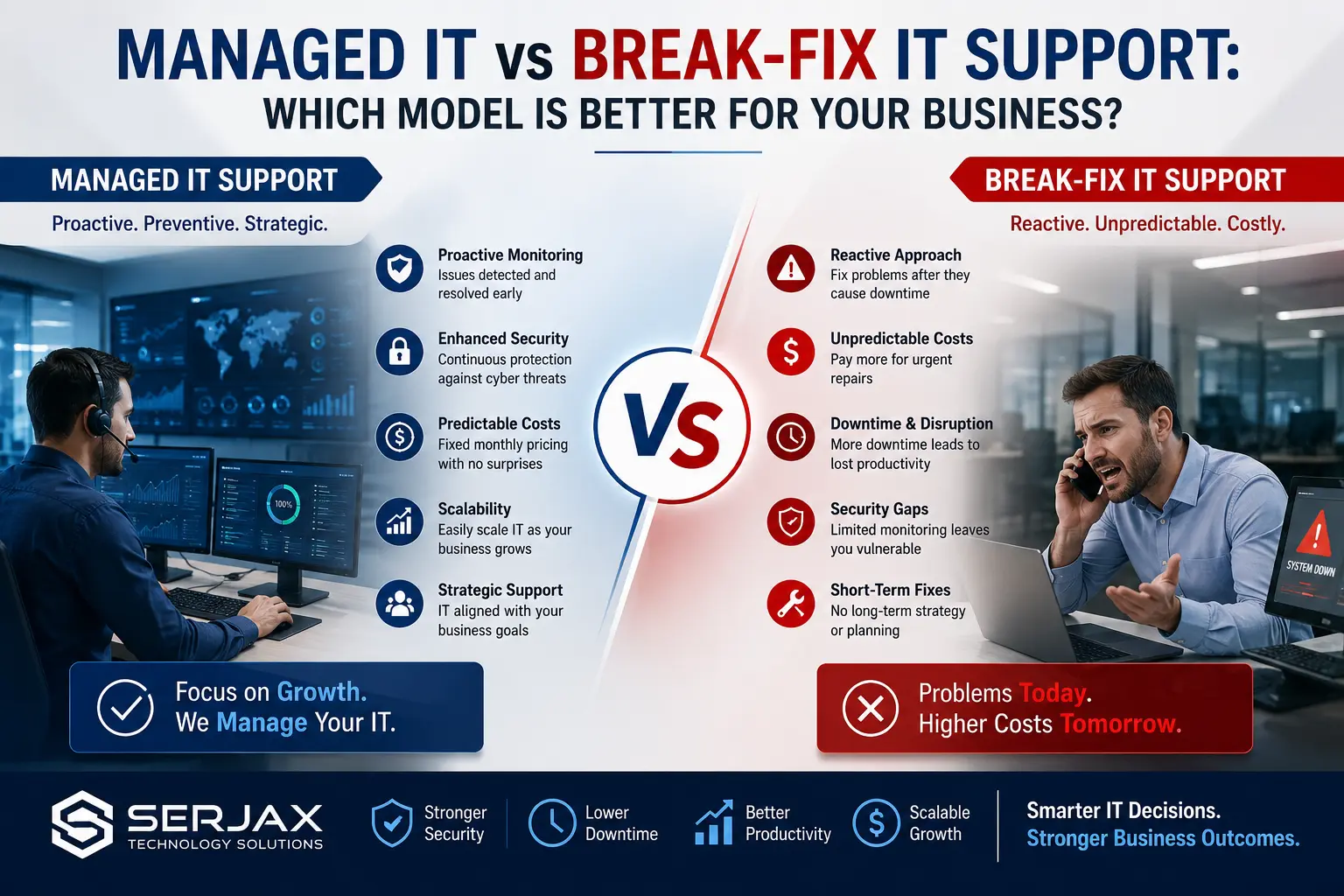
In today’s digital business environment, choosing the right IT support model is critical for productivity, cybersecurity, and long term growth. The debate around managed IT vs break fix support has become increasingly important as businesses rely more heavily on technology for daily operations.
While some companies still depend on the traditional break fix approach, many are now moving toward managed IT services for proactive monitoring, security, and scalability.
However, deciding between these two IT support models is not always straightforward. Each approach has its own advantages, costs, and business impact.
Therefore, understanding how both models work can help organizations make smarter technology decisions.
In this guide, we will compare managed IT and break fix IT support in detail, explore their pros and cons, and explain why businesses are increasingly partnering with providers like Serjax for proactive IT management and cybersecurity support.
What is Managed IT Support?
Managed IT support is a proactive service model where a third party provider continuously monitors, manages, and maintains a company’s IT infrastructure for a fixed monthly fee.
Instead of waiting for systems to fail, managed IT providers work to prevent issues before they disrupt operations.
Typically, managed IT services include:
- 24/7 network monitoring
- Cybersecurity management
- Cloud infrastructure support
- Data backup and disaster recovery
- Software updates and patch management
- Helpdesk and remote support
- Strategic IT planning
As a result, businesses experience fewer disruptions, stronger security, and more predictable IT costs.
What is Break-Fix IT Support?
Break-fix IT support is a reactive model where businesses only contact an IT provider when something breaks or stops working.
In this setup:
- A problem occurs
- The business contacts a technician
- The issue gets repaired
- The business pays for the service
Although this model may seem cost effective initially, it often leads to higher long-term costs due to downtime, emergency repairs, and productivity losses.
Moreover, break-fix support usually lacks strategic IT planning and proactive cybersecurity protection.
Managed IT vs Break-Fix: Core Difference
The primary difference between these models is simple:
| Managed IT Support | Break-Fix IT Support |
|---|---|
| Proactive approach | Reactive approach |
| Prevents issues before they occur | Fixes issues after failure |
| Monthly predictable cost | Variable repair cost |
| Continuous monitoring | No ongoing monitoring |
| Strong cybersecurity focus | Limited security planning |
| Long-term IT strategy | Short-term problem solving |
Therefore, the choice often depends on whether a business wants prevention or reaction.
Why Businesses Are Moving Toward Managed IT Services
Technology is becoming more complex every year. Consequently, businesses can no longer afford constant downtime or weak cybersecurity.
Here are some major reasons companies are switching to managed IT services:
Reduced Downtime
Managed IT providers monitor systems continuously. Therefore, potential issues are detected and resolved before they affect operations.
Better Cybersecurity
Cyber threats are evolving rapidly. Managed IT services provide:
- Endpoint protection
- Threat monitoring
- Firewall management
- Security updates
- Employee awareness support
As a result, businesses become more resilient against ransomware and phishing attacks.
Predictable IT Costs
Unlike break-fix support, managed IT services usually operate on a fixed monthly fee. This makes budgeting easier and eliminates surprise repair expenses.
Strategic IT Planning
Additionally, managed IT providers help businesses align technology with long term goals through proactive IT strategy and infrastructure planning.
Advantages of Managed IT Support
Managed IT services offer several long-term business benefits.
Proactive Problem Prevention
Rather than waiting for systems to fail, issues are identified early through monitoring and maintenance.
Improved Productivity
Employees experience fewer disruptions, allowing teams to focus on work instead of technical problems.
Scalability for Growth
As businesses grow, managed IT solutions scale efficiently without major infrastructure disruptions.
Access to Expert Knowledge
Businesses gain access to experienced IT professionals without hiring a full internal team.
Stronger Compliance Support
Managed IT providers often assist with industry compliance requirements and security standards.
Advantages of Break-Fix IT Support
Although managed IT is becoming more popular, break-fix support may still suit certain businesses.
Lower Initial Costs
Businesses only pay when problems occur. Therefore, small companies with minimal IT needs may initially prefer this model.
No Long-Term Contracts
Break-fix services usually operate on-demand without monthly commitments.
Suitable for Very Small Operations
Companies with limited technology usage sometimes find break-fix support adequate for their needs.
However, this model becomes less effective as businesses scale and depend more heavily on digital systems.
Hidden Risks of Break-Fix IT Support
While break-fix may appear cheaper at first, hidden costs can become significant over time.
Unplanned Downtime
Every minute of downtime affects productivity, customer experience, and revenue.
Higher Emergency Repair Costs
Urgent repairs often cost more than proactive maintenance.
Weak Cybersecurity
Break-fix support rarely includes ongoing security monitoring or threat prevention.
Lack of IT Strategy
Without long-term planning, businesses may struggle with outdated systems and inefficient infrastructure.
Consequently, many organizations eventually outgrow the break-fix model.
Cybersecurity Comparison: Managed IT vs Break-Fix
Cybersecurity is one of the biggest differences between the two models.
| Security Area | Managed IT | Break-Fix |
|---|---|---|
| Continuous monitoring | Yes | No |
| Threat prevention | Proactive | Reactive |
| Security updates | Automated | Occasional |
| Backup management | Included | Often manual |
| Compliance support | Strong | Limited |
| Disaster recovery planning | Available | Rare |
Clearly, managed IT services provide much stronger protection against modern cyber threats.
Cost Comparison Between Both Models
Many businesses focus only on upfront costs. However, long-term value matters more.
| Cost Factor | Managed IT | Break-Fix |
|---|---|---|
| Monthly fee | Fixed | None |
| Emergency repair costs | Lower | Higher |
| Downtime losses | Reduced | Increased |
| Cybersecurity expenses | Preventative | Reactive |
| Productivity impact | Minimal disruption | Frequent interruptions |
Although managed IT involves recurring costs, it often saves businesses money through prevention and efficiency.
Which Model is Better for Small Businesses?
For small businesses that rely heavily on technology, managed IT support is usually the better long-term investment.
This is especially true for businesses that:
- Store customer data
- Use cloud applications
- Depend on remote work
- Need cybersecurity protection
- Want predictable IT costs
However, very small companies with minimal IT infrastructure may still use break-fix support temporarily.
Even then, proactive monitoring becomes increasingly important as businesses grow.
How Managed IT Services Support Business Growth
Growth requires reliable technology infrastructure. Managed IT services help businesses scale by providing:
Cloud Infrastructure Support
Cloud systems improve flexibility, collaboration, and scalability.
Strategic IT Roadmaps
Managed providers help businesses plan future upgrades and technology investments.
Business Continuity Planning
Disaster recovery strategies reduce downtime during unexpected incidents.
Remote Workforce Support
Additionally, managed IT providers ensure secure remote access and collaboration tools.
As a result, companies can expand operations more confidently.
Why Businesses Choose Serjax for Managed IT Services

Businesses looking for reliable IT support and cybersecurity solutions often partner with Serjax for proactive technology management.
Serjax helps companies by:
- Monitoring systems 24/7
- Preventing downtime before it happens
- Strengthening cybersecurity frameworks
- Supporting cloud infrastructure
- Providing scalable IT solutions
- Delivering strategic IT guidance
Moreover, Serjax focuses on aligning technology with business growth goals rather than simply fixing technical issues after they occur.
This proactive approach helps organizations improve efficiency, reduce risk, and maintain operational stability.
Signs Your Business Needs Managed IT Services
Many companies continue using break-fix support longer than they should.
Here are common signs it may be time to switch:
- Frequent downtime or recurring IT problems
- Increasing cybersecurity concerns
- Slow systems affecting productivity
- Growing remote workforce
- Rising IT repair costs
- Lack of internal IT expertise
If these challenges sound familiar, managed IT services can provide a more stable and scalable solution.
Future of IT Support: Proactive vs Reactive
The future of IT support is clearly moving toward proactive service models.
Modern businesses require:
- Continuous uptime
- Advanced cybersecurity
- Cloud infrastructure management
- Remote work support
- Scalable systems
Therefore, reactive break-fix support alone is no longer enough for most growing companies.
Businesses that invest in proactive IT management today are better prepared for future challenges and digital transformation.
FAQ’s
What is the difference between managed IT and break-fix support?
Managed IT is proactive and focuses on preventing issues, while break-fix support is reactive and fixes problems after they occur.
Is managed IT more expensive than break-fix?
Although managed IT has a monthly fee, it often reduces long-term costs by preventing downtime and emergency repairs.
Which model offers better cybersecurity?
Managed IT services provide significantly stronger cybersecurity because they include continuous monitoring and threat prevention.
Is break-fix IT support outdated?
Not completely, but it is becoming less effective for businesses that depend heavily on technology and cloud systems.
Why are businesses switching to managed IT services?
Businesses want better security, predictable costs, reduced downtime, and strategic IT support for growth.
Why choose Serjax for managed IT support?
Serjax offers proactive monitoring, cybersecurity expertise, scalable infrastructure support, and strategic IT guidance tailored for growing businesses.
Conclusion
Choosing between managed IT vs break fix support can significantly impact business productivity, security, and long-term growth. While break-fix support may work for very small organizations with limited IT needs, most modern businesses benefit more from proactive managed IT services.
Managed IT provides continuous monitoring, stronger cybersecurity, predictable costs, and strategic technology planning. In contrast, break-fix support often leads to reactive spending, downtime, and limited scalability.
With trusted providers like Serjax, businesses can move beyond reactive IT support and build a more secure, scalable, and future-ready technology environment.
More from Serjax: managed IT services · free 24-point IT audit · AI automation