In today’s digital economy, cybersecurity is no longer optional for businesses. Every company in Ireland—whether a small startup or a large enterprise—relies on technology to store data, communicate with clients, and run operations. However, as digital dependence grows, so do cyber threats.
Cyberattacks such as ransomware, phishing, and data breaches can cause financial loss, reputational damage, and legal consequences. Therefore, businesses must take proactive steps to protect their systems and sensitive data.
This practical guide explains the key cybersecurity risks for Irish businesses and the essential steps companies can take to stay protected. It also highlights how professional IT partners like Serjax Services help businesses strengthen their security posture.
Why Cybersecurity Is Critical for Businesses in Ireland
Ireland has become a major hub for technology companies and digital services. As a result, businesses of all sizes store valuable information such as:
-
Customer data
-
Financial records
-
Business strategies
-
Intellectual property
Unfortunately, cybercriminals actively target such data.
Moreover, regulations like GDPR require companies to safeguard personal data. If a business fails to protect customer information, it could face severe fines and legal issues.
Key Reasons Businesses Must Prioritize Cybersecurity
-
Increasing number of cyberattacks on SMEs
-
Strict data protection regulations
-
Financial and operational risks from breaches
-
Growing reliance on cloud and remote work
Therefore, investing in cybersecurity is not just a technical decision—it is a business necessity.
Common Cybersecurity Threats Facing Irish Businesses
Understanding the threats is the first step toward preventing them. Below are the most common cyber risks businesses encounter.
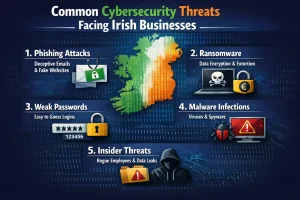
1. Phishing Attacks
Phishing emails trick employees into revealing sensitive information such as passwords or payment details. These emails often appear to come from trusted sources.
2. Ransomware
Ransomware locks or encrypts company data until a payment is made. Consequently, businesses may lose access to important files for days or even weeks.
3. Weak Passwords
Many cyberattacks succeed because of weak or reused passwords. Therefore, companies must enforce strong password policies.
4. Malware Infections
Malicious software can infiltrate systems through downloads, email attachments, or compromised websites.
5. Insider Threats
Sometimes the risk comes from inside the organization. Employees may accidentally expose sensitive data or misuse access privileges.
Cybersecurity Risks vs Business Impact
The following table shows how different cyber threats can affect business operations.
| Cyber Threat | Potential Impact on Business |
|---|---|
| Phishing | Financial fraud, data leaks |
| Ransomware | Operational downtime |
| Malware | System damage and data theft |
| Weak passwords | Unauthorized system access |
| Insider threats | Data exposure or compliance issues |
Therefore, businesses must implement strong security controls to minimize these risks.
Essential Cybersecurity Measures for Businesses
Protecting your business requires a combination of technology, policies, and employee awareness. Fortunately, several practical steps can significantly improve cybersecurity.
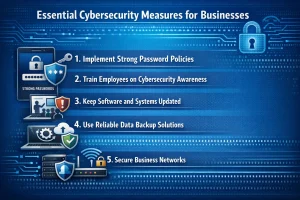
1. Implement Strong Password Policies
First, businesses should require strong and unique passwords for all accounts.
Best practices include:
-
Use passwords with at least 12 characters
-
Enable multi-factor authentication (MFA)
-
Avoid password reuse across platforms
As a result, attackers will find it much harder to access company systems.
2. Train Employees on Cybersecurity Awareness
Employees are often the first line of defense. However, many cyberattacks succeed because staff members unknowingly click malicious links.
Therefore, companies should regularly provide training on:
-
Identifying phishing emails
-
Safe browsing habits
-
Secure password management
-
Handling sensitive data
When employees understand cyber risks, they can help prevent many attacks.
3. Keep Software and Systems Updated
Outdated software often contains security vulnerabilities. Cybercriminals frequently exploit these weaknesses.
Consequently, businesses should:
-
Install software updates regularly
-
Apply security patches promptly
-
Upgrade outdated operating systems
Regular updates significantly reduce security risks.
4. Use Reliable Data Backup Solutions
Data backups are essential for disaster recovery. If ransomware or hardware failure occurs, backups allow businesses to restore operations quickly.
A strong backup strategy should include:
-
Automated daily backups
-
Offsite or cloud storage
-
Regular backup testing
This ensures business continuity even after a cyber incident.
5. Secure Business Networks
Network security is another critical layer of protection.
Companies should implement:
-
Firewalls
-
Endpoint protection software
-
Secure Wi-Fi networks
-
Network monitoring tools
These measures help detect and block suspicious activity before it causes damage.
The Role of Managed IT Services in Cybersecurity
While some businesses attempt to manage cybersecurity internally, this approach can be challenging. Technology evolves rapidly, and cyber threats become more sophisticated each year.
Therefore, many companies partner with professional IT providers such as Serjax Services. Managed IT experts monitor systems, implement security controls, and respond quickly to threats.
Benefits of Professional Cybersecurity Support
Working with an experienced IT provider offers several advantages:
-
24/7 system monitoring
-
Advanced threat detection
-
Data protection and compliance support
-
Regular security updates and audits
-
Faster response to cyber incidents
As a result, businesses gain peace of mind while focusing on their core operations.
Cybersecurity Best Practices Checklist
Businesses should regularly review their cybersecurity posture. The following checklist provides a simple starting point.
Cybersecurity essentials:
-
Use multi-factor authentication
-
Train employees on phishing awareness
-
Backup data regularly
-
Install antivirus and endpoint protection
-
Update software and systems frequently
-
Monitor network activity
-
Partner with trusted IT professionals
When these measures work together, businesses create a strong defense against cyber threats.
Why Irish Businesses Are Taking Cybersecurity More Seriously
Cybersecurity awareness among Irish businesses has increased significantly in recent years. Companies now understand that even small organizations can become targets.
Furthermore, digital transformation, remote work, and cloud computing have expanded the attack surface.
Therefore, businesses increasingly rely on trusted IT partners like Serjax Services to secure their infrastructure and maintain compliance with data protection regulations.
Final Thoughts
Cybersecurity is a critical responsibility for every business operating in Ireland. Without proper protection, companies risk data breaches, financial losses, and damage to their reputation.
However, by implementing strong security practices, training employees, and partnering with experienced providers like Serjax Services, businesses can significantly reduce their exposure to cyber threats.
Ultimately, cybersecurity should be viewed not as a cost but as an investment in the long-term stability and success of your business.
Read more : IT Support in Westmeath: What Businesses Should Expect From a Reliable IT Partner
FAQ’s
1. Why is cybersecurity important for businesses in Ireland?
Cybersecurity protects sensitive business data, prevents financial losses, and ensures compliance with data protection regulations such as GDPR. Strong security measures also help businesses maintain customer trust and operational stability.
2. What are the most common cyber threats for businesses?
Common threats include phishing attacks, ransomware, malware infections, weak passwords, and insider threats. These risks can lead to data breaches, system downtime, and financial damage.
3. How can small businesses improve cybersecurity?
Small businesses can improve cybersecurity by using strong passwords, enabling multi-factor authentication, training employees, updating software regularly, and partnering with IT providers like Serjax Services for ongoing protection.